This blog chronicles an inquiry into the minds and hearts of 30 leaders who serve, to discover what motivates, engages and sustains them. I am grateful to each of these leaders for their generosity of time and spirit, and the shared insight and wisdom that will inspire and incite other leaders to serve.
Friday, February 24, 2012
Sustainability
South Africa is such a complex society. The diversity in landscape along with the people is breathtakingly beautiful. Everyone has an opinion about life after Apartheid, but most agree that the government is struggling to change a system that went quickly from oppression when Apartheid ended, to attempts to right past wrongs through social welfare that was not sustainable. It seems that what is on everyone's mind here is how to improve opportunity through education and employment--instead of providing handouts, promoting hand-ups. The country, like so many other African nations is filled with NGO's attempting to partner with local communities to do this work as well. I interviewed one such leader, Paul Durant, Director of the South African branch of Habitat for Humanity here in Capetown.
Paul is another example of a young entrepreneur who made it big in the IT business, but found the chase after money and things to be unsatisfying. He was born to a privileged life in South Africa and migrated to the UK for schooling and business. The gap between rich and poor in both places was a wake up call that his life needed to be about something else. Upon volunteering with Habitat and other NGO's he discovered a different type of satisfaction that occurred concurrently with it a spiritual awakening. Now he leads the South African arm of Habitat in Capetown.
He is attempting to shift the focus of Habitat from home building alone (handout) to community development in partnership with other agencies that can meet the needs of any given community (hand-up) including the training and development of local community councils, enabling them to take over the sustainability of aid provided once the NGOs move on. Paul is attempting to develop the people in his office in much the same way. Once again, I discovered the true merit of a Servant Leader is being smart enough and invested enough to work yourself out of a job!
Wednesday, February 22, 2012
Apartheid, Corruption and Redemption
Corruption comes in many forms: ideas, practices, policies and personifications. South Africa is a conundrum of the first order, with a history of white European hegemony and current political realities infected by corruption and bankrupt ideology. As Wikepedia describes "in 20th-century political science, the concept of hegemony is central to cultural hegemony, a philosophic and sociologic explanation of how, by the manipulation of the societal value system, one social class dominates the other social classes of a society, with a world view justifying the status quo of bourgeois hegemony". What the Afrikaans perpetrated on the native Africans, immigrant Indians and so-called "coloreds" during Apartheid was horrific and seemingly unforgivable- people categorized as subhuman and treated with less respect and dignity than that of cattle. Unlike Rwanda, truth and reconciliation has been an uphill battle here, perhaps because Apartheid was carefully and fully realized for over fifty years and was institutionalized so completely into the culture, rather than the swift and unimaginable genocide of Rwanda of one tribe pitted against another with white supremacists pulling the strings in the background. In any case, the current rule of the ANC (African National Congress)seems a far cry from what Nelson Mandela desired. Corruption is recognized as problematic be you black or white, with short term pocket filling rationalized as deserved rather than investment in long term vision for a sustainable future. I don't suggest that I understand the complexities, only that deep complex evolution to an enlightened and equal future remains elusive. Nelson Mandela and Desmond Tutu played critical roles in the peaceful and mostly non-violent transition to a democratic society, but as they have entered their golden years, successors of their merit are sorely needed.
The irony here in Capetown is represented in the beautiful upscale suburbs juxtaposed against township slums with a population of over one million.
Education and healthcare seem to have taken a backseat to social welfare programs that offer short term benefit, but lack long term results. Redemption is somewhat recognizable in a rich diversity that appears to be working on the surface-black, white, Indian, Muslim, Christian, and on and on- a crazy quilt of interaction characterized by a willingness to talk about the present day issues--- but still looking for more....
Monday, February 20, 2012
Letting Go
My father passed away 26 years ago and upon his death I asked for a birthstone ring that he wore for as long as I could remember. It was on the hand that I often held as a little girl. Shortly after his death I took the ring to a jeweler and had the gold melted and reshaped into a ring that I could wear as a remembrance of him and our shared November birthdays over the years. I remember him as a gentle, loving, sensitive father and leader who had a wicked sense of humor. I lost the citrine stone in that ring about six months ago and have been perseverating about it ever sense. About 15 years ago I visited Ireland for the first time-the traditional discover your roots trip-and felt very connected to the beauty of the people and land as well as the golden tones of Jameson Irish Whiskey. While there, I purchased a gold medallion that was a replica of a druid worship stone combining the ancient circular patterns of continuity of the druid spirits with the first Christian symbol of a cross marking the impact of St. Patrick's arrival about 400 AD. For me this symbolized my homeland and a universal spirituality that spoke to my belief system. I have worn that necklace virtually every day and night sense. While walking to the Waterfront here in Cape Town yesterday, that necklace was ripped off my neck by a young robber. I was really upset at loosing this precious object until I started thinking of some of the lessons learned on this journey. The particular lesson that kept coming to me was the one about "letting go". The ring is not my father and the medallion is not my heritage. The problem with possessions is that we want to protect them and hang on at all costs. The same can be said for money, fame, and power-many of the causes of toxic leadership. And what about ideas and perceptions to which we form attachments:prejudice, narrow mindedness,singular interpretations? I am reminded once again that focusing on the small stuff gets in the way of focusing on the right stuff and that letting go is the only way to let new insight come. What might you be holding on to that is holding you back?
Thursday, February 16, 2012
Putting It All On The Line
When your goal is nothing short of transformation, be it an organization, community or a country, you have to "go all in". Lip service, halfheartedness, short sightedness, or incompetence won't do. Today's interviews accentuated strategic thinking and skillful facilitation as necessary accompaniments to a service heart. The CRWRC (Christian Reformed World Relief Committee) is engaged in some powerful and unusual leadership in Kenya, a country that has been challenged with conflict, divisive leadership and ethnic/tribal disparities.
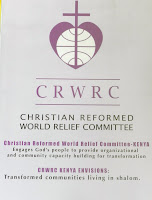
Under the recent leadership of Fred Witteveen, the organization has refocused on a new mission that seeks sustainable transformation through conflict mitigation and facilitative processes informed by his skill in
"Deep Democracy" (http://deep-democracy.net/) The lesson here: servant leaders need to be more than humble, value centered and committed. The leader becomes a more successful instrument of change when armed with skill, tools, networks, and leverage for resourcing the work to larger scale. His journey included coming to terms with his own white privilege and using the access and opportunity it provides for the sustainable transformation of communities in need-forward action rather than regret and guilt.
One of the program directors, Stephan Lutz, hosted us at a marvelous Ethopian Restaurant for his interview. He is a remarkable young man, with wisdom and insights beyond his years and desire to keep growing and learning as a servant leader.
Part of our discussion centered around the indigenous wisdom that existed but was
not valued upon the arrival of colonists and missionaries. In the fervor to bring "truth" and "salvation" to the natives, so many original and important insights were dismissed, particularly concerning self reliance and reverence for the environment. Lesson here-leaders need to recognize and appreciate the natural intelligence of those they lead and avoid the seduction of "knowing better". Instead our job is to facilitate collective and inherent knowledge to bring about solutions that just need uncovering and consensus to move forward. We also talked about Gandhi, Christ and St. Francis and their ability to let go of the trappings of leadership, allowing them to be fully with the people they served, not over. Thank you Stephan and Fred for an enlightening day.
Wednesday, February 15, 2012
Rosemary Nyerere
What a fantastic day this was. I made a wonderful new friend in the person of Rosemary Nyerere, the daughter to of the late President Julius K. Nyerere, Baba wa Taifa, father of the nation and the leader of the nonviolent revolution that led to independence from British Rule in 1961. We traveled out of the Serengeti to his home village of Butiama near Lake Victoria. There is a small but satisfying museum there that tells of his life and accomplishments as well as his former home when President, only steps from the site of his birth and burial.
Mwalimu(teacher) Nyerere was known for his farsighted vision for Tanzania, the unification of the nation, the establishment of Swahili as the national language (no small feat with over 120 tribes and dialects), free access to public education, an ongoing commitment to the eradication of illiteracy, conservation of the land, self sustainability of village life and preservation of the nature, with the establishment of over 25% of the land know within National Park Preservation status.
We had an independently guided orientation to his museum followed by coffee with Rosemary. She is quite the accomplished woman herself, having been in Parliament here as well as a college lecturer in Mathematics. It was such an honor and joy to meet here. She openly shared loving memories of her father and described him in eerily similar fashion as Tara Gandhi for her grandfather: an amazing ability to focus totally on the person at hand, the belief in the good in every human being and the ability to bring out the best in them, deep empathy for those who suffer, and an early and fierce recognition of injustice and unfairness. She described a man of deep intellect, social genius and an unwavering love for his family and country.
"When he died, we all lost a father-the entire nation. But I never minded sharing him, because he was home every night to be with his family, giving us his undivided attention as if he hadn't a care in the world. That was his gift."
Sunday, February 12, 2012
Human to Human
We had the privilege of visiting three different tribal villages around Lake Elaysi-real villages not for tourists.
The first was the most ancient tribe in Africa, WaHadzabe who speak click language,better known as Bushman. They have retained their hunting and gathering lifestyle over thousands of years, and are only 2000 remaining in Tanzania with some additional in South Africa. They are a matriarchal society with woman making the decisions, marrying multiple males and reserving intimacy for those who have a successful hunt.
They need arrows to hunt and don't make them themselves, so they depend on the nearby WaDatoga who are herders and farmers (corn/maize) and blacksmiths. They are a patriarchal society and we visited a relatively wealthy clan with four wives (50 head of cattle for each wife) The women were beautiful and delightful and the younger males who were not out tending the herd, demonstrated their arrow and spearhead making process, using recycled aluminum, brass and copper from pieces bought at market. They have bellows made from cowhide that heats the ash rapidly to melt down the metal for reshaping and honing into fine hunting instruments.The women asked me to try my hand at grinding the maze between two stones with a rhythmic motion while they sang in the background. Musical rhythm made the labor much easier, more enjoyable and higher quality.
Our last stop was WaMasaai, the warrior tribe you have probably heard about. They are nomadic herders with a diet consisting totally of meat, milk and blood (taken from the carotid artery with no damage to the animal). They are known as warriors because they used to aggressively take land from other tribes. The government has put a stop to the aggression, encouraged settlement, schooling and farming, so their way of life is slowly changing. A very warm welcome here but more for opportunistic reasons. We had a wonderful tour of the village by the elder's son who had been away at school and learned business strategies-heavy selling of the beautiful beaded handicrafts that WaMasaai are known for. My future doc students will reap the benefit of an amazing beaded talking stick, that was just too tempting to pass up. The Masaai trade for the beads and the beautiful fabric they wear at local village markets, again depending on the talents of others in return for the meat and milk that they can provide.
Mutual benefit, mutual gain. What we witnessed were the most fundamental human capacities for creativity and collaboration, service to others and satisfaction for and survival of self.
Friday, February 10, 2012
Symbiosis
My doctoral students often debate whether service is really service if you reap some benefit from it. Watching the natural world makes this debate seem moot. In nature there is a mutual dependency that serves each other and keeps the system working.
Wildebeasts are rather dimwitted so they follow the zebra in migration to water and food sources, the zebra use the accompanying wildebeasts for additional protection from predators. Warthogs often hang out with taller animals who can see farther in the distance, (ie girafe, zebras, elephants) and the tall ones enjoy the sharp sense of smell close to the ground that warthogs provide-again offering, mutual protection (service) for all.
There is a Whistling Thorn tree here that feeds and houses thousands of ants in its large seed pods, and in return the ants attack any animal predator that disturbs the leaves of the tree.
For those of you who remember Selfish Gene theory, you'll recognize the theme-man evolved virtuosity toward others for mutual gain and protection. It's much safer to get along in groups when surrounded by a threatening environment. Even Gandhi, who believed in selfless service to mankind without any benefit to self, enjoyed a higher level of consciousness because of the way he chose to live his life. Perhaps such transactions are necessary and natural, even when transformation occurs.
Subscribe to:
Posts (Atom)